

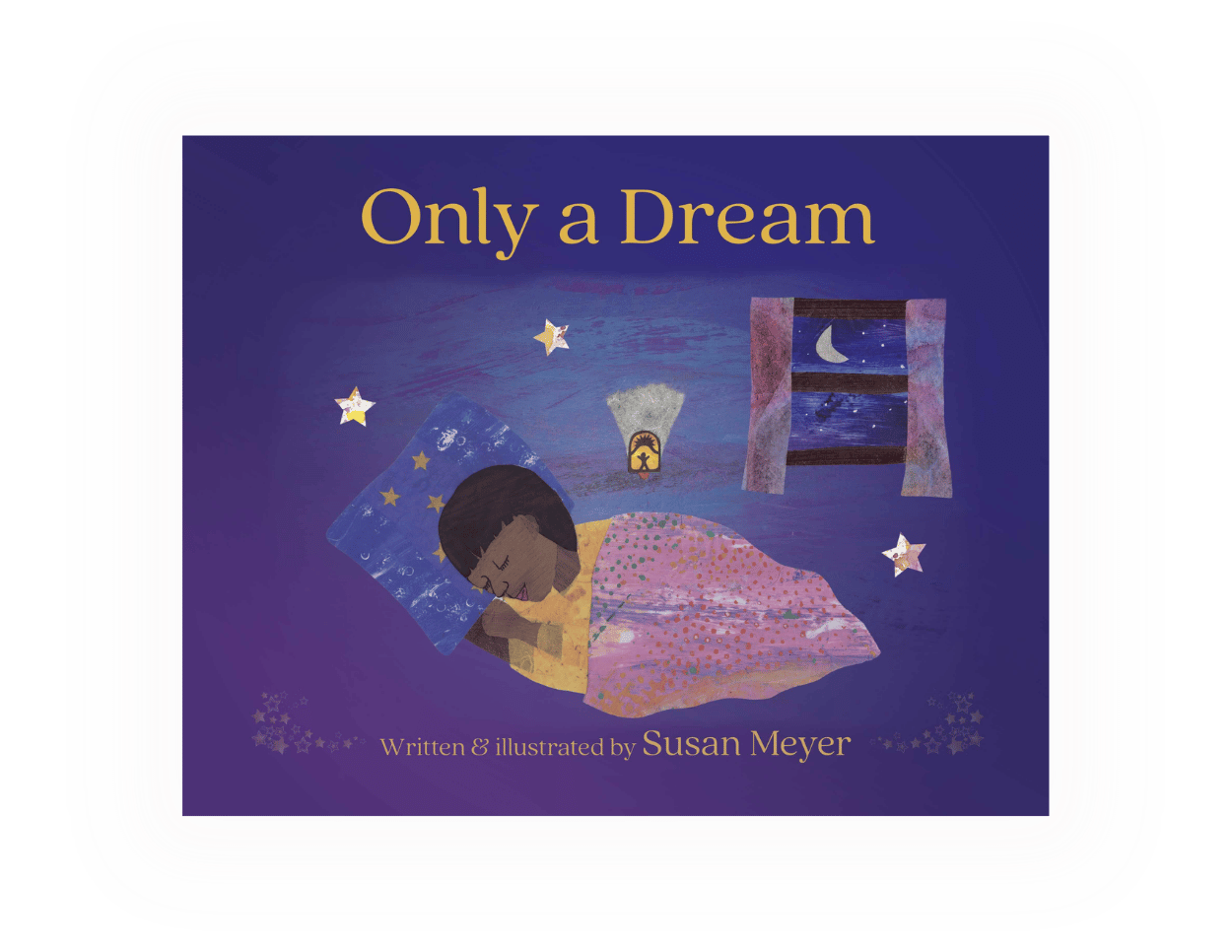
Only a Dream
For every child who has ever woken up afraid—and every adult who has sat with them in the dark.
Ages 4 to 8
About the Book
Only a Dream is a rhyming picture book for children ages 4 to 8 that addresses nightmares and nighttime fears through a framework of empowerment, mindfulness, and emotional literacy. Through the story of a child who wakes frightened from a series of vivid nightmares, the book offers a toolkit of strategies for transforming fear into courage and self-understanding. Best enjoyed as a shared read-aloud experience between children and the caring adults in their lives.
The tissue paper collage illustrations—some of which incorporate childhood drawings by the author’s children—give the book a handmade, dreamlike visual quality that complements its subject matter. The narrative draws on Jungian dream psychology, presenting nightmare figures not as threats to be escaped but as messengers to be understood. It introduces children to mindfulness concepts including emotional awareness, the practice of lucid dreaming, and the calming power of visualization.
The book contains an Author's Note with extension activities and discussion questions to help families and educators go deeper with the book’s themes, and a Guided Visualization for Bedtime script for use as a nightly calming practice.
Written and illustrated by a former kindergarten and preschool teacher, meditation teacher, and mother, Only a Dream integrates principles from child development, transpersonal psychology, and contemplative practice into an accessible, warmly illustrated story.

bedtime guided visualization
Your white light of protection
This short meditation invites children to imagine a ball of white light all around them and others they love, offering a sense of protection and peace through the night. I did this visualization with my own children at bedtime for several years, and my daughter now continues the tradition with her own daughter. My granddaughter has listened to this recording hundreds of times and still asks for it every night. You can choose to listen to the recording below, read the script that follows the story in the book, or listen on Insight Timer.


This meditation invites children to send kind wishes outward in widening circles—beginning with themselves, then a dear friend, then a child they don’t know well, and eventually to all children everywhere. It draws on the Buddhist practice of lovingkindness (metta)—a widely practiced meditation that research suggests reduces anxiety and promotes emotional wellbeing in children.
There are two versions: gentle and extended. Start with the gentle version, and stay with it for a while so your child can get used to the practice. If you sense they are ready, the extended version gently introduces the idea that even children we find difficult share our common experience of fear and the wish to feel safe—a powerful seed of empathy and understanding. However, there’s no rush; lovingkindness practice is meant to be easy. Follow your child’s lead. If they don’t feel ready to send kind wishes to someone they find hard to get along with, staying with the gentler version is perfectly fine.
The lovingkindness phrases in this practice focus on: sleeping peacefully, feeling safe, and waking up happy in the morning.
If this meditation becomes a regular part of your bedtime routine, your child may enjoy going through their day, looking for who they will practice with in each category at night. You can do it alongside your child, sending well-wishes to individuals in the same categories for you. You might even tell each other who you’re bringing into the practice each evening.
BEDTIME LOVINGKINDNESS
A calming and connecting practice
Your Special Place Guided visualization
Take an imagination vacation to a peaceful refuge
One of the most powerful gifts we can give children is the knowledge that peace is always available—not just in the world around them when conditions are right, but within themselves. This gentle visualization (also available on Insight Timer) guides children to find their own peaceful place in nature and reminds them that they can return to their inner sanctuary anytime, whenever they need a breath of calm. Best enjoyed at bedtime, snuggled under the covers with eyes closed. You can choose to listen to the recording below, read the script that follows the story in the book, or listen on Insight Time
Beyond the Story
The story is the beginning of the conversation. Here are some ways to explore further with the children in your life.
Get Creative
Draw, describe, or act out your nightmare. Getting it out of your head and into the world makes it feel smaller.
Draw or imagine your nightmare looking friendly or silly rather than scary.
What superpowers could you give yourself in a scary dream? What would you do with them? Make a list of your dream superpowers, to use either during the dream or afterward. (Some ideas: Become invisible, fly, or possess superhuman strength. Hypnotize or freeze dream characters—or make them laugh. Put yourself inside a bubble of protective white light. Be a movie director, and tell the characters what to do and when to end the scene. Use magical words, an object with special powers, or a gesture to take you to a safe and happy place.)
Tell a Story
Write, tell, and/or illustrate a story about a nightmare you’ve had. Since you are the author, you can change it however you’d like, and even give it a happy ending (and use your dream superpowers).
Act out the story as the scary character or retell it from that character’s point of view.
Write, imagine, or act out a prequel or sequel to the nightmare.
Keep a dream journal. Decorate a blank notebook or create a moon book (instructions below) to keep by your bed for recording and illustrating your dreams.
Set a Positive Bedtime Tone
Every night at bedtime, think of five things you’re grateful for from the day. You can write them in a gratitude journal or simply bring them to mind.
Imagine your own special safe place, where you feel completely peaceful and protected. Imagine the details with all of your senses.
Reflect Together
What makes you feel safe and peaceful at bedtime? Do you have any special objects, stories, or rituals that help?
What strategies did the child in the story use to manage night fears? Do you think any of them would work for you? Which would you most like to try?
Do you have any other ideas for coping with nightmares or night fears?
If you could give advice to another child who was having nightmares, what would you tell them?
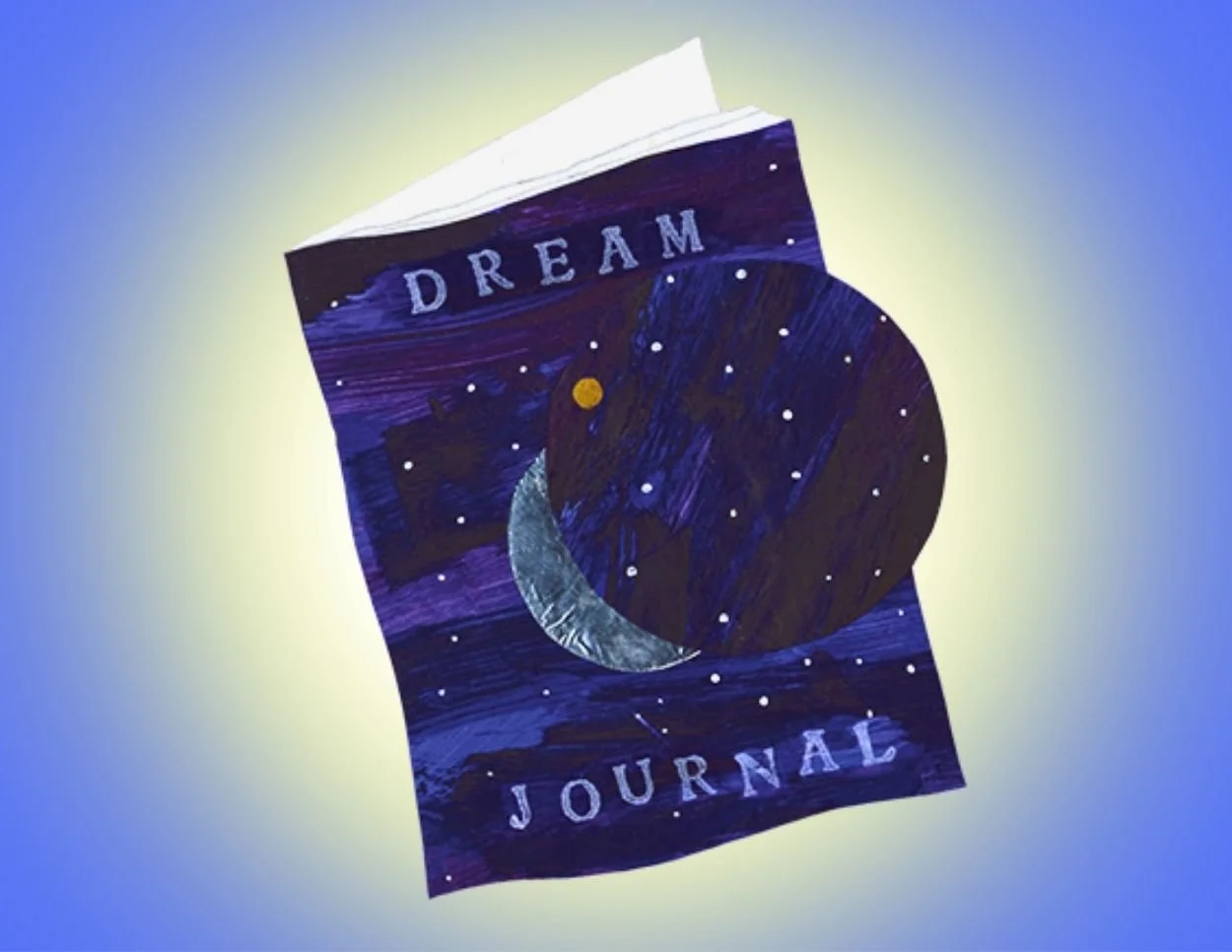
make a moon dream journal
The cover of this book replicates the phases of the moon!
Materials
3 sheets of black cardstock (you may be able to find some with silver flecks (alternatively, I recommend painting cardstock with acrylic paint and/or glittery stars)
Several sheets of good quality white paper
Round lid or bowl about 7” in diameter
Sharp pencil
Scissors
Stapler
Round lid or cup about 3 1/2” in diameter
4”x4” piece of aluminum foil, white cardstock, or watercolor paper (if using watercolor paper, you might want to pain it in soft tones to resemble the moon)
Round lid or cup about 4 1/2” in diameter
Glue
Brad (metal paper fastener)
Black duct tape or dark washi tape
Instructions: Round Book
With a pencil, trace around the lid or bowl to make a circle on two sheets of black cardstock. Carefully cut out the circles.
Trace the same-sized circle onto several sheets of white paper; then cut them out. These will be the pages of your book, so make as many as you want.
Make sure the black covers and white pages are lined up neatly, and staple them together close to an edge.
Using the smallest lid, trace a circle onto the dull side of the aluminum foil (or white cardstock or watercolor paper) with a pencil. Carefully cut out the circle.
Using the middle-sized lid, trace a circle onto the remaining sheet of black cardstock. Carefully cut it out.
Glue the aluminum, white, or watercolored circle to the center of the front cover.
With a brad or tiny hole-punch, carefully poke a hole through the middle-sized, black circle about 3/8” inch from the top.
With the brad, carefully poke a hole through the front cover 1 cm (slightly less than ½”) above the top of the glued-on circle. (Orient book so the staples are on the left-hand side.) With the brad, attach the black circle over the light-colored circle so the former can swivel and replicate the phases of the moon. Note: In order to achieve a full moon effect, it is important to position the black circle slightly above the light-colored circle. You may want to test the movement before poking the hole.
Cover the back of the brad and the staples with small pieces of black electrical tape.
Instructions: Rectangular Moon Book
Follow instructions for the round book, except for steps 1 to 3.
Instead of tracing and cutting circles, simply fold one sheet of 8½” x 11” dark cardstock in half so it measures 8½” tall by 5½“ wide.
Fold each sheet of (8½” x 11”) white paper in half.
Unfold the cardstock and paper, and stack them carefully so the cardstock is on top.
Using a long-arm stapler, staple three times along the fold. (If you don’t have a long-arm stapler, you can use a standard stapler to staple close to the left edge. For a more finished look, cover the staples with decorative, dark washi tape or black duct tape wrapped around the spine so that both the front and back of all the staples are covered with one piece of tape.)
Other Uses
Record your dreams in words and/or drawings.
List a few things you’re grateful for at the end of each day.
Write some soothing bedtime reminders.
On each page, name or draw a magical superpower you can use to change your dreams (either during or after the dream).
Go outdoors or look out a window when the moon is full each month and write about what you notice in nature.
Write poems (maybe haikus) about the moon and nighttime.

About the Author
SUSAN MEYER, M.A. is a mother, grandmother, meditation teacher, and former kindergarten and preschool teacher. She has studied Jungian psychology and worked with her own dreams for decades, guided by the belief that dreams are a doorway to deeper self-understanding. She enjoys teaching both children and adults how to meet their thoughts and emotions with mindfulness and care.
She wrote and illustrated Only a Dream as part of her master’s thesis in Education when her children were in elementary school, incorporating some of their own childhood drawings into the illustrations. After completing her degree, she began teaching kindergarten and set the book aside, intending to get it published when the time was right.
Twenty years later, after publishing her first book for adults (River Time: Mindful Reflections from the Upper Hudson), she was staying overnight with her grandchildren when the youngest woke up crying in the night, afraid there was a monster in his room. Susan returned home and began putting the finishing touches on Only a Dream so she could publish it independently—which, over the decades, had become much easier to do.
Susan’s favorite bedtime comfort object is a heart-shaped rose quartz. She lets it rest in her hand or in the notch at the bottom of her ribcage, where it takes on her body heat and feels warm and soothing.